
KARAGANDA BEARING
UNITS FACTORY
“Precision in every detail — confidence in every result”
ABOUT COMPANY → OWN
PRODUCTION
 COMPLIANCE WITH
GOST AND ISO
 QUALITY
CONTROL
 SUPPLY ACROSS
KAZAKHSTAN AND THE COMMONWEALTH OF INDEPENDENT STATES
INDUSTRIES OF APPLICATION
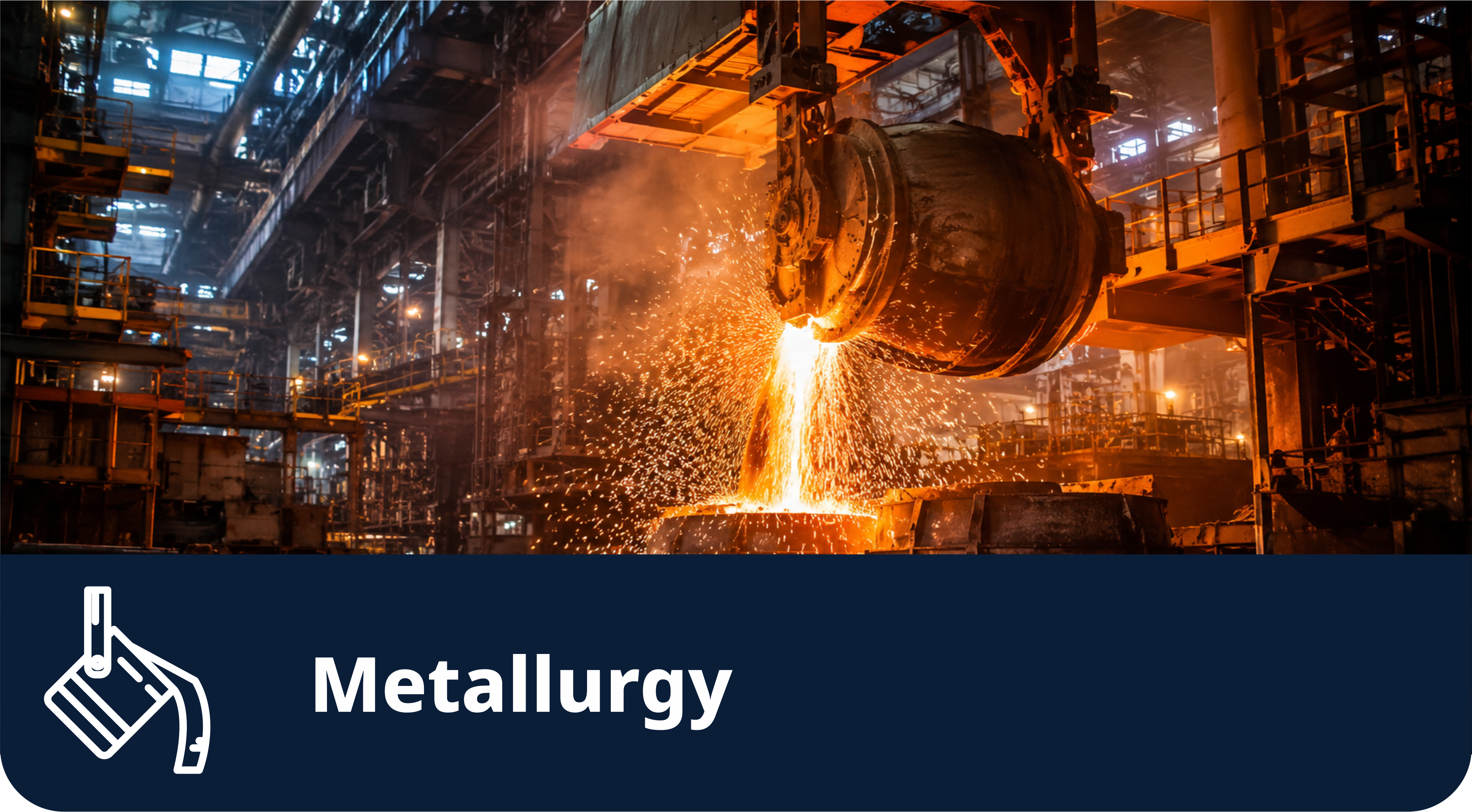
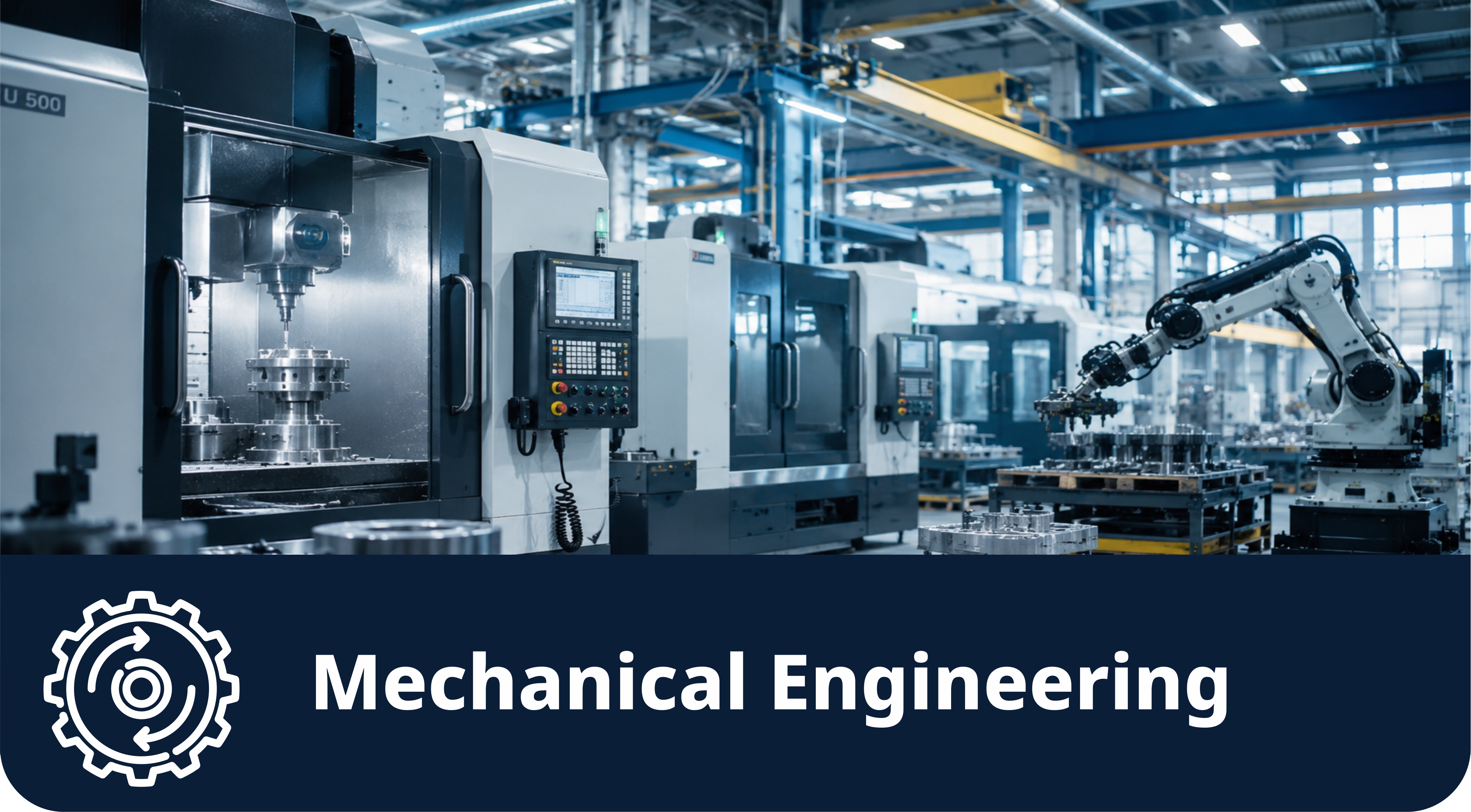






RELIABILITY
Modern equipment and strict quality control at every stage of production

STANDARDS COMPLIANCE
Products comply with GOST, ISO and international standards

FAST DELIVERIES
Fast delivery across Kazakhstan, the Commonwealth of Independent States and neighboring countries

TECHNICAL SUPPORT
Product selection assistance and consultations from our specialists
TYPES OF BEARINGS PRODUCED
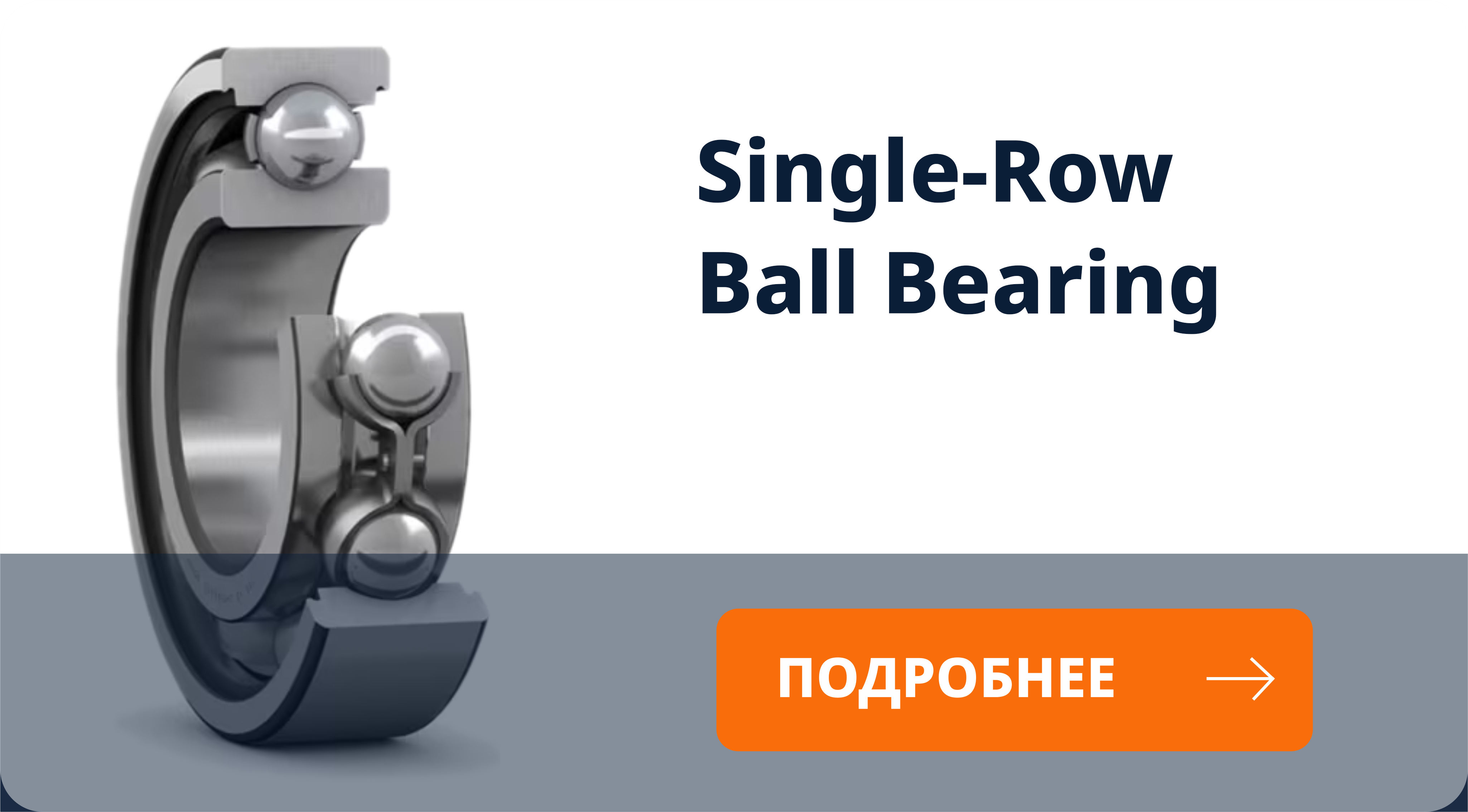
Single-Row Ball Bearing
Single-row radial ball bearings are among the most widely used types of rolling bearings and are applied in many types of machines and mechanisms. The bearing design includes raceways on the inner and outer rings, with a radius slightly larger than the radius of the balls, ensuring stable and efficient operation of the unit. This bearing type is mainly intended to carry radial loads, but it can also carry axial loads in both directions. Due to low friction torque, these bearings are especially effective at high rotational speeds and with minimal power losses. Single-row radial ball bearings are produced in open designs and in closed designs with metal shields or rubber seals on one or both sides. Closed designs are usually filled with grease for the entire service life. Some designs use retaining rings to simplify installation and bearing fixation in the housing. The most common cage type for these bearings is a stamped steel cage, valued for strength and manufacturability.
Main characteristics:
• high rotational speed;
• low coefficient of friction;
• accurate and smooth operation;
• simple installation and maintenance;
• operation across a wide temperature range.
Application area: electric motors, pumps, fans, gearboxes, machine tools, transport equipment, household mechanisms and industrial mechanisms. Bearings of this type ensure reliable operation of rotating assemblies, reduce part wear and increase equipment service life.
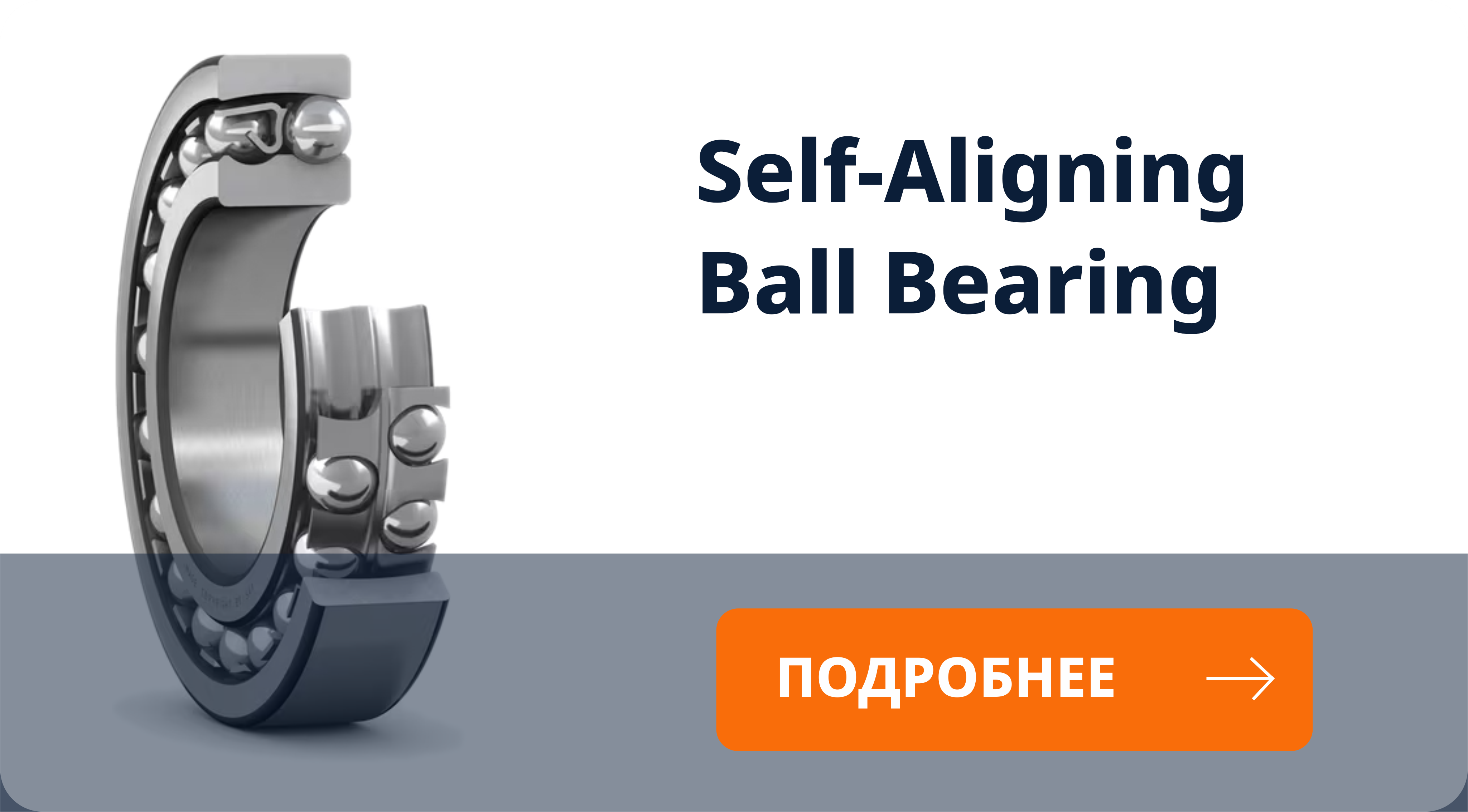
Self-Aligning Ball Bearing
In a self-aligning ball bearing, the inner ring has two raceways, while the outer ring has one common spherical raceway whose center of curvature coincides with the bearing axis. This design allows the inner ring, together with the balls and cage, to tilt slightly relative to the outer ring. This feature automatically compensates for minor misalignment between the shaft and housing caused by manufacturing errors, deformation or installation inaccuracies. It improves the reliability of the bearing unit and reduces the risk of additional loads.
Main characteristics:
• ability to carry high radial loads and moderate axial loads in both directions;
• ability to compensate for angular misalignment;
• high reliability under vibration and impact loads;
• increased load capacity compared with single-row ball bearings;
• operation in structures with insufficient rigidity and housing deformation.
Design: consists of inner and outer rings, two rows of balls, and one common cage or two separate cages. The outer ring has a spherical surface that provides the self-aligning function.
Application area: gearboxes, fans, conveyors, agricultural machinery, mining equipment, metallurgical equipment and machines with increased vibration and possible shaft misalignment. Bearings of this type ensure stable equipment operation, reduce wear and extend unit service life.
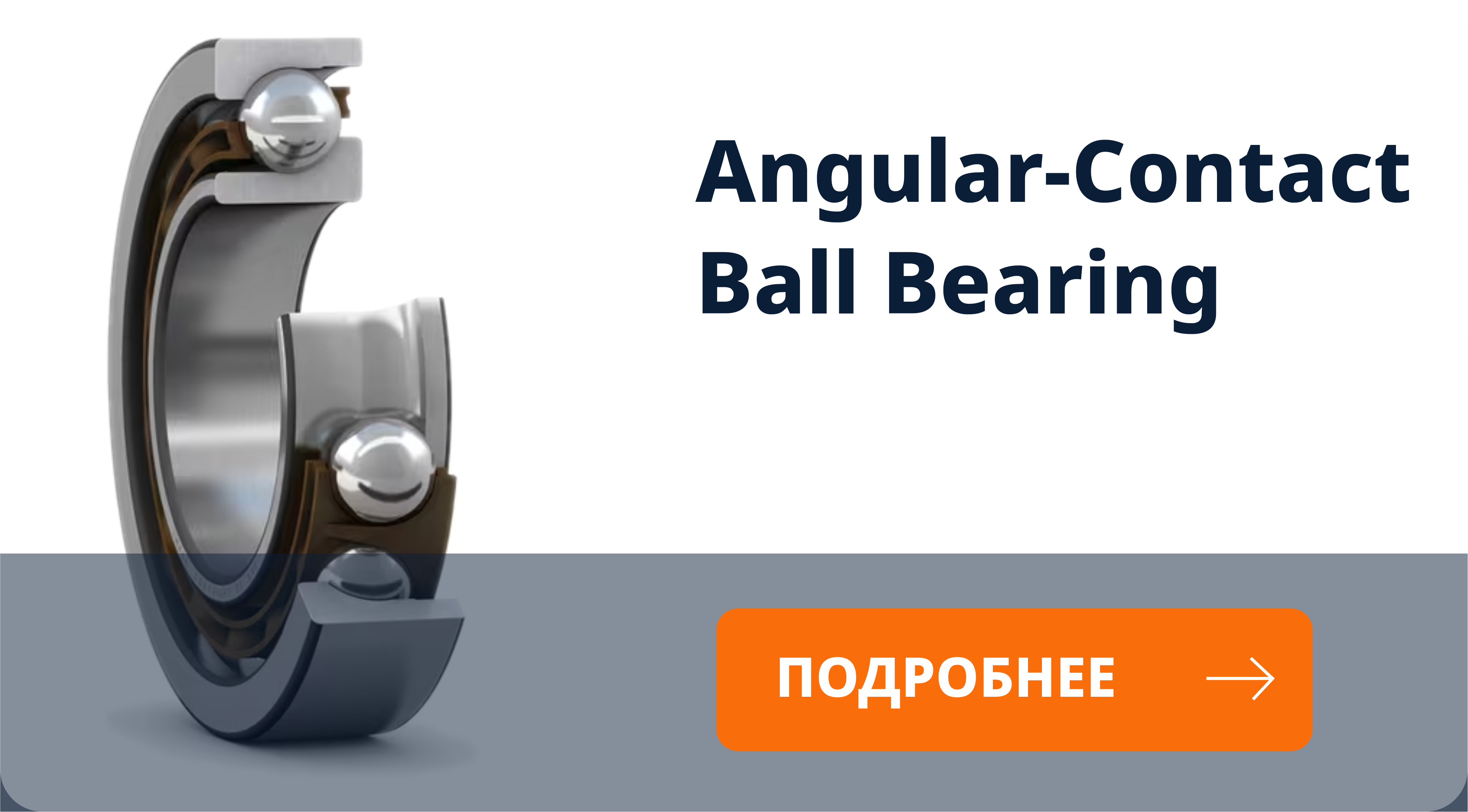
Angular-Contact Ball Bearing
Angular-contact ball bearings are distinguished by their ability to carry radial and axial loads acting simultaneously in one direction. Their design includes a contact angle, and the value of this angle determines the operating characteristics of the bearing. Bearings of this type are manufactured with contact angles of 15 degrees, 25 degrees, 30 degrees and 40 degrees. As the contact angle increases, the ability to carry axial loads increases, while smaller contact angles are more suitable for high rotational speeds. In most cases, angular-contact ball bearings are installed in pairs, allowing axial loads to be carried in both directions and making it possible to achieve the required internal clearance or preload.
For cages, brass is usually used; steel is used less often. In high-precision bearings with a contact angle below 30 degrees, polyamide cages are often used because of their low weight and good antifriction properties.
A combination of two bearings operating together in one unit is called a duplex pair. Such pairs are most often formed from angular-contact ball bearings or tapered roller bearings. Duplex pairs increase unit rigidity, carry combined loads and improve mechanism accuracy.
Main duplex arrangement schemes:
• face-to-face arrangement, type DF, where load lines converge toward the axis of the bearing unit;
• back-to-back arrangement, type DB, where load lines diverge outward;
• tandem arrangement, type DT, where both bearings operate together in one direction.
DF and DB arrangements can carry radial and axial loads in both directions. The DT tandem arrangement is used when significant axial loads act in one direction and allows the load to be distributed evenly between two bearings.
Main characteristics:
• ability to carry radial and axial loads in one or both directions;
• high rotational accuracy;
• operation at high speeds;
• rigidity and stable operation under increased loads;
• paired installation for increased axial load capacity.
Design: consists of inner and outer rings, balls, a cage and special raceways with a defined contact angle. The contact angle determines the bearing ability to carry axial loads.
Application area: spindles of metalworking machines, pumps, compressors, gearboxes, electric motors, aviation equipment, industrial drives and high-speed mechanisms. Bearings of this type provide accuracy, reliability and stable equipment operation under combined loads.
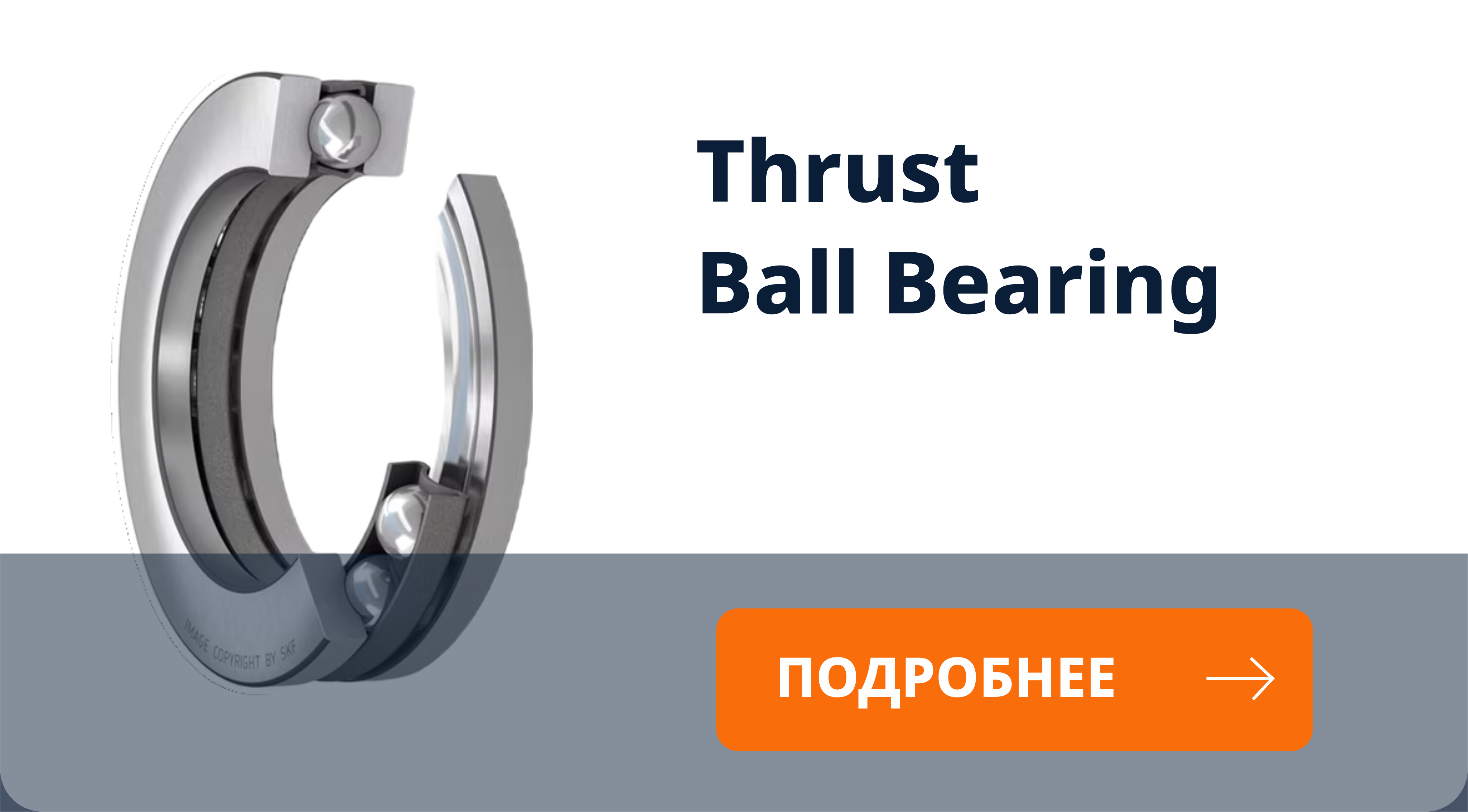
Thrust Ball Bearing
Single-direction thrust ball bearings consist of washer-shaped rings with raceways. The ring connected to the shaft is called the shaft washer, while the outer ring is called the housing washer. Double-direction thrust ball bearings additionally include a third central washer as a separate element and a second set of balls, allowing loads to be carried in different operating modes. A spherical seating washer may be used under the housing washer to compensate for misalignment and installation errors. Small-size bearings usually use stamped steel cages, while large-size designs use machined cages made of steel or brass.
Main characteristics:
• ability to carry high axial loads;
• low coefficient of friction;
• operation at high rotational speeds, depending on the design;
• high shaft positioning accuracy;
• compact design and simple maintenance.
Design: consists of one or two thrust washers with raceways, balls and a cage. Depending on the design, it may be single-direction or double-direction and can carry axial loads in one or both directions.
Application area: vertical shafts of electric motors, pumps, gearboxes, machine tools, lifting mechanisms, turbines, rotary devices and other industrial equipment. Bearings of this type provide stable operation of units carrying axial forces and improve mechanism reliability.
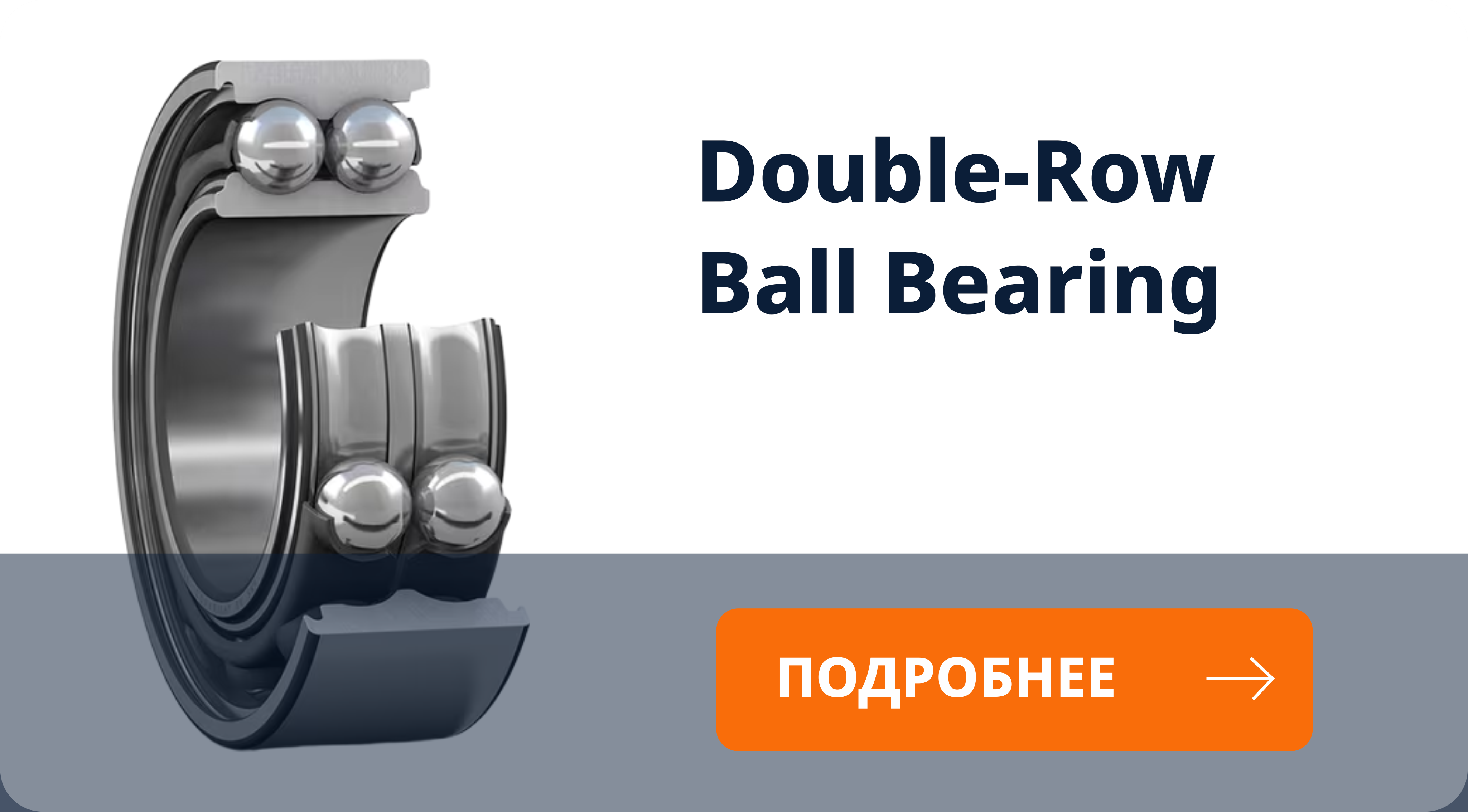
Double-Row Ball Bearing
Double-row angular-contact ball bearings are equivalent in operating characteristics to a pair of single-row angular-contact bearings installed in a back-to-back arrangement. Their design includes one inner ring and one outer ring with two raceways, providing compactness and increased rigidity of the bearing unit. Bearings of this type can carry radial loads and axial loads acting in both directions at the same time. They are widely used in units requiring high accuracy, reliability and resistance to combined loads.
Main characteristics:
• ability to carry high radial and axial loads;
• operation under axial loads in two directions;
• increased rigidity and stable rotation;
• good shaft positioning accuracy;
• reliable operation at moderate and high rotational speeds.
Design: consists of inner and outer rings, two rows of balls and a cage. The raceways have a contact angle that enables combined load transmission. The design distributes the load evenly between two rows of rolling elements.
Application area: pumps, electric motors, gearboxes, machine tool drives, compressors, textile equipment, transport mechanisms and industrial equipment requiring combined load capacity. Bearings of this type provide high reliability, rotational accuracy and increased service life of assemblies.
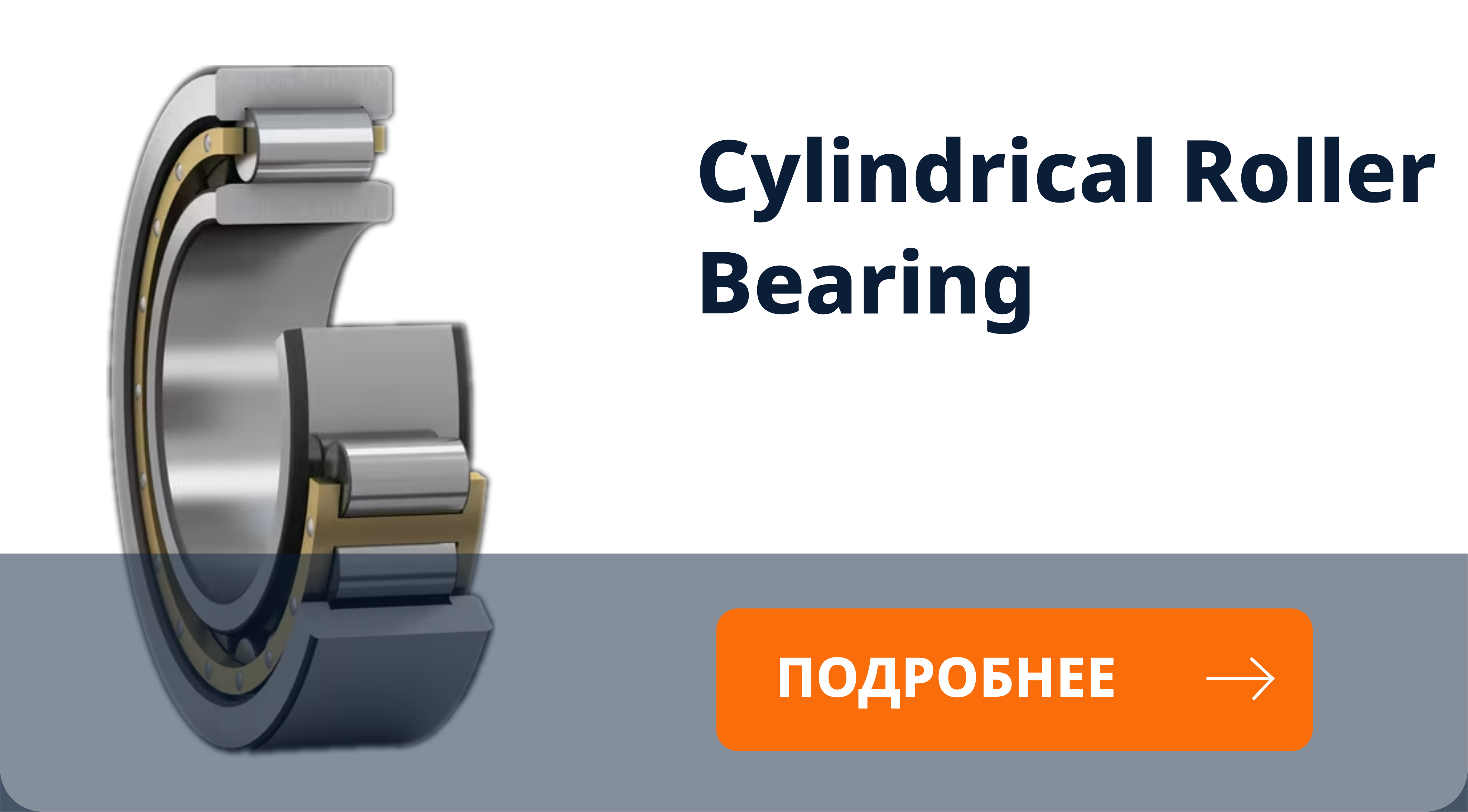
Cylindrical Roller Bearing
In cylindrical roller bearings, the rolling elements are cylindrical rollers that contact the raceways along a line, providing high radial load capacity and increased resistance to loads. Because of this design, bearings of this type operate effectively at high rotational speeds.
Single-row cylindrical roller bearings are produced in different designs and are designated by types NU, NJ, NUP, N and NF. Double-row designs are designated as NNU and NN. The structural differences between the types are determined by the position of ribs on the rings and the ability to carry axial loads.
In most designs, the inner and outer rings are separable, which greatly simplifies bearing installation and removal. Some designs have no ribs on one of the rings, allowing axial displacement of the rings relative to each other. Such bearings are used as supports with free shaft displacement.
Bearings in which one ring has two ribs and the other has one rib can carry axial loads in one direction. Double-row cylindrical roller bearings provide high radial rigidity and are widely used in precision equipment and machine tool building. Steel and brass cages are mainly used, while polyamide cages are used less often, primarily in high-speed designs.
Main characteristics:
• high radial load capacity;
• high rigidity and resistance to impact loads;
• ability to operate under heavy loads and moderate rotational speeds;
• low rotational resistance;
• high accuracy and reliable operation.
Design: consists of inner and outer rings, short cylindrical rollers and a cage. Depending on the design, it may have separable rings, which simplifies installation and maintenance.
Application area: electric motors, gearboxes, rolling mills, mining equipment and metallurgical equipment.
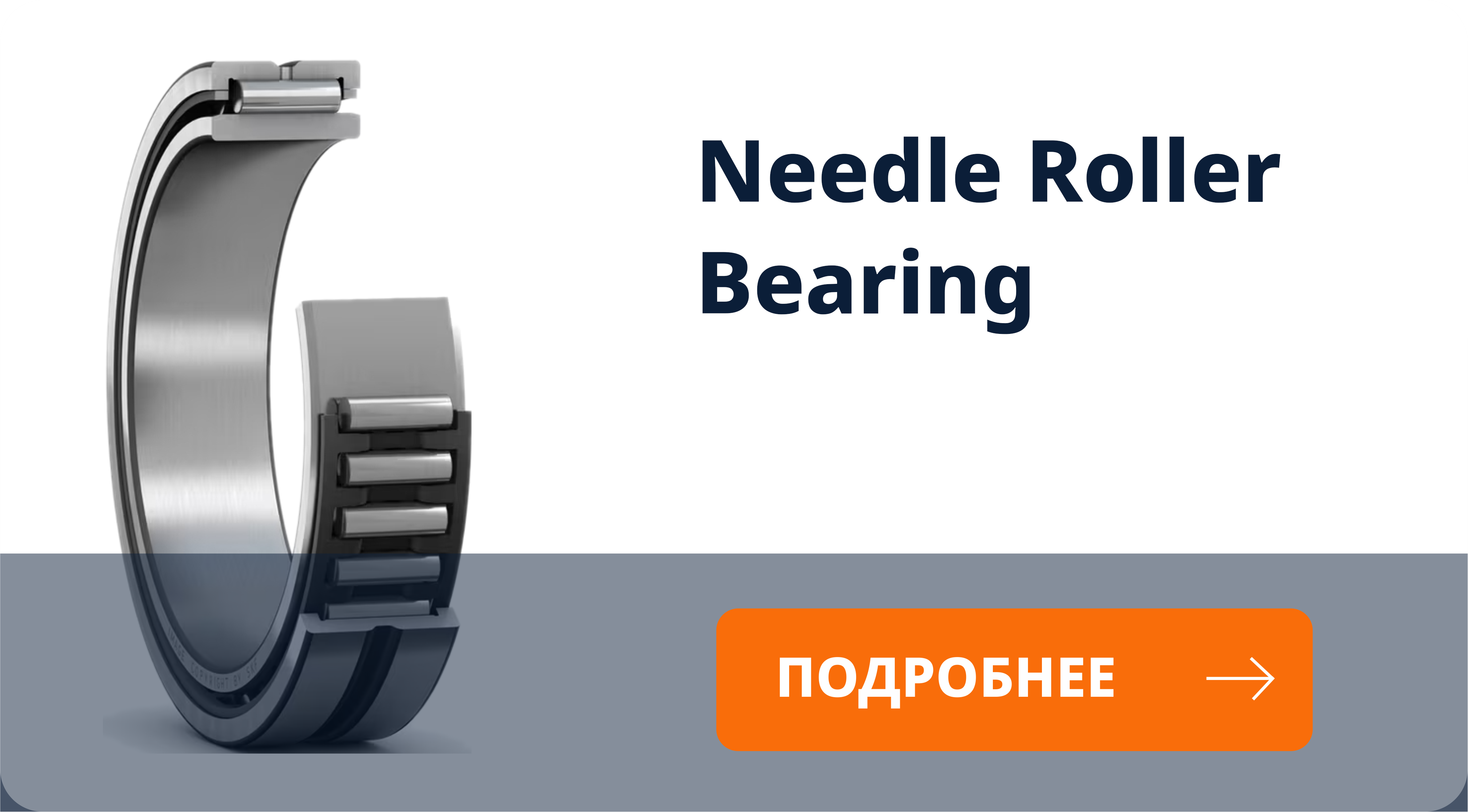
Needle Roller Bearing
Needle roller bearings use thin cylindrical rollers called needles as rolling elements, with a length usually ranging from three to ten times their diameter. Due to the small cross-section of the rollers and compact design, these bearings have high radial load capacity despite relatively small overall dimensions. The small ratio between the outer bearing diameter and the inscribed circle diameter makes needle roller bearings effective in assemblies with limited installation space. Many needle roller bearing designs are produced without an inner ring, allowing the shaft surface itself to serve as the raceway. By design, there are bearings with a stamped outer ring and bearings with a solid machined outer ring, which provide increased rigidity and accuracy. Cage and roller assemblies without rings are also widely used for compact and heavily loaded mechanisms. Most designs use stamped steel cages, although cage-free designs also exist, allowing more rollers to be used and increasing bearing load capacity.
Main characteristics:
• high radial load capacity in compact dimensions;
• high rigidity and ability to carry impact loads;
• small radial dimensions;
• low rotational resistance;
• efficient operation in limited installation space.
Design: consists of inner and outer rings, or may be designed without one of the rings, long cylindrical or needle rollers and a cage. A large number of rollers provides increased load capacity and even load distribution.
Application area: automotive transmissions, gearboxes, reducers, pumps, compressors, machine tools, textile machines, agricultural machinery and other mechanisms with limited space for bearing installation. Bearings of this type provide high load capacity, operating accuracy and long unit service life.
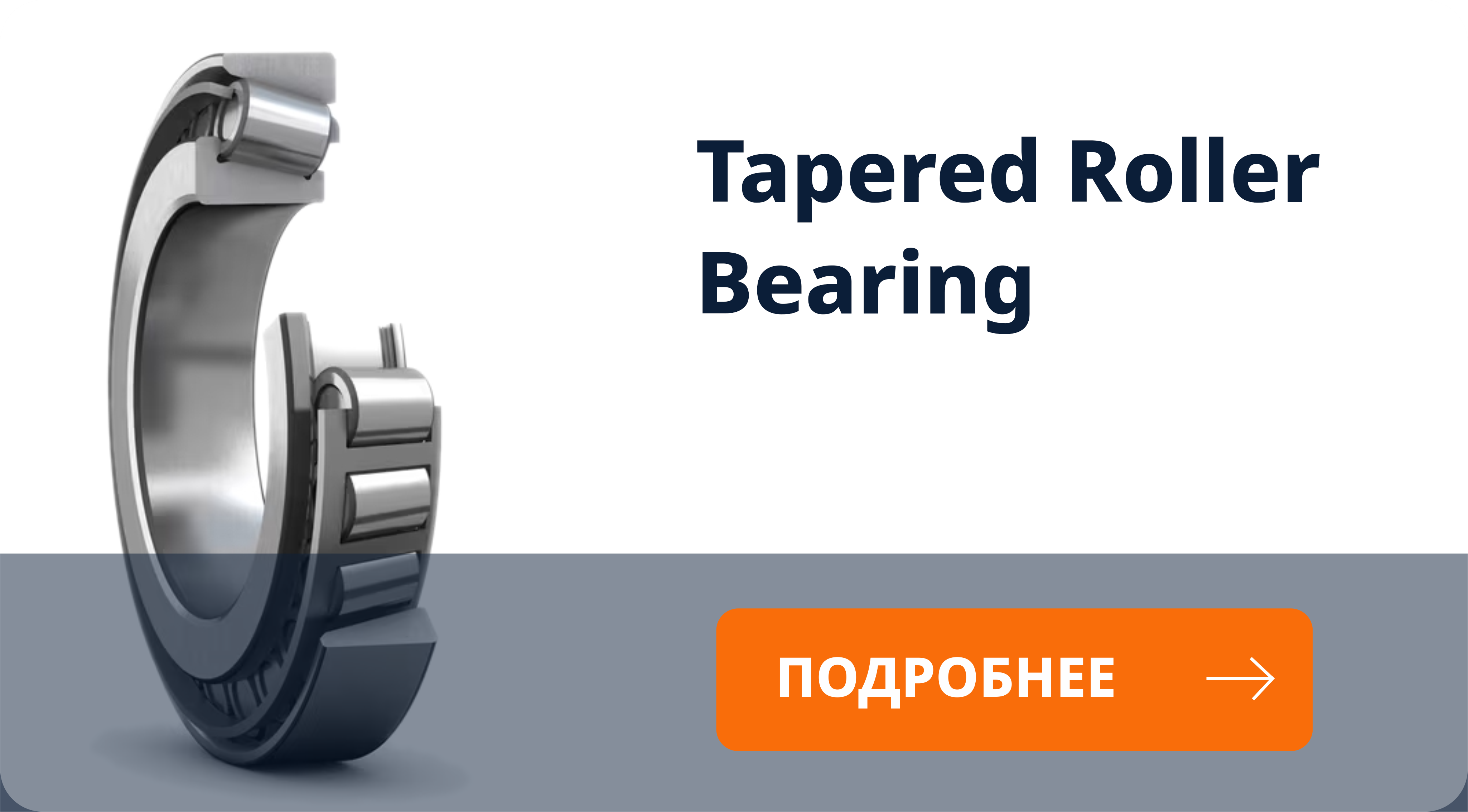
Tapered Roller Bearing
Bearings of this type are equipped with tapered rollers guided by the rib of the inner ring. They have high radial and axial load capacity and mainly carry axial loads in one direction. Because the design is separable, inner rings with cages and outer rings can be installed separately, making assembly easier. Depending on the contact angle, tapered roller bearings are divided into three types: normal angle, medium angle and increased angle. In addition to single-row designs, double-row and four-row tapered roller bearings are also produced for operation under increased loads. Most designs use stamped steel cages.
Main characteristics:
• high radial and axial load capacity;
• high rigidity and resistance to impact loads;
• ability to carry combined loads;
• possibility of axial clearance adjustment;
• reliable operation at moderate rotational speeds.
Design: consists of inner and outer rings with tapered raceways, tapered rollers and a cage. It usually has a separable design, which simplifies installation, removal and maintenance.
Application area: automotive wheel hubs and transmissions, gearboxes, mining equipment, metallurgical equipment, rolling mills, agricultural machinery, railway assemblies and heavy industrial mechanisms. Bearings of this type provide high reliability, rotational accuracy and durability under combined loads.
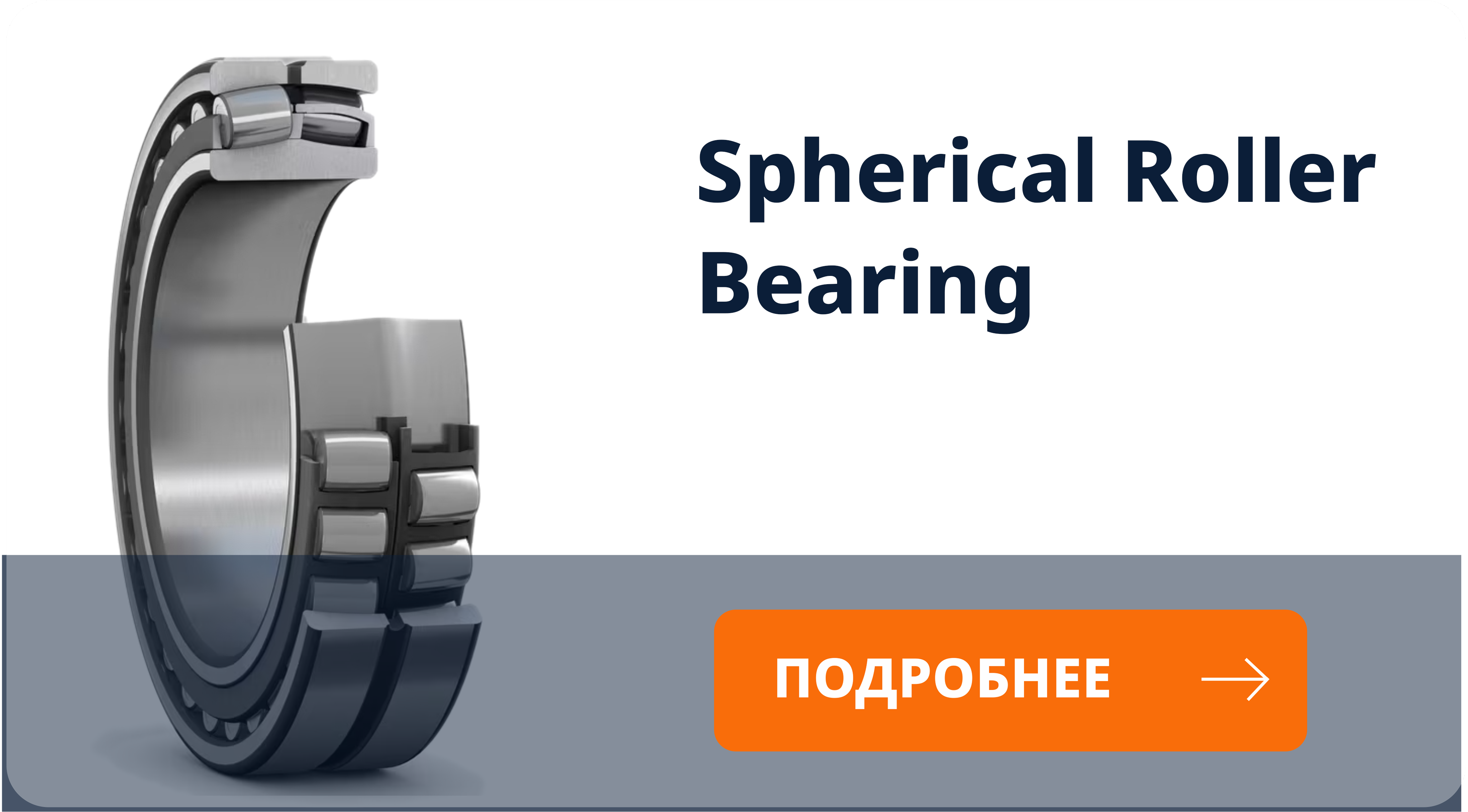
Spherical Roller Bearing
In spherical roller bearings, barrel-shaped rollers are located between the inner ring with two raceways and the outer ring with one spherical raceway. This design provides self-aligning capability, because the center of curvature of the outer ring raceway coincides with the bearing axis. As a result, the bearing can compensate for angular deviations of the shaft and housing caused by manufacturing errors, installation inaccuracies or deformation during operation. Bearings of this type can carry both radial and axial loads in both directions. They are distinguished by high radial load capacity and can operate effectively under heavy and impact loads.
Main characteristics:
• high radial and axial load capacity;
• ability to compensate for shaft misalignment relative to the housing;
• resistance to impact loads, vibration and deformation;
• high rigidity and long service life;
• stable operation under heavy industrial conditions.
Design: consists of inner and outer rings, two rows of spherical barrel-shaped rollers and a cage. The spherical raceway of the outer ring provides the self-aligning function.
Application area: mining equipment, metallurgical equipment, crushers, mills, conveyors, gearboxes, fans, agricultural machinery, paper machines and heavy industrial installations. Bearings of this type ensure reliable equipment operation under high loads, vibration and possible shaft misalignment.
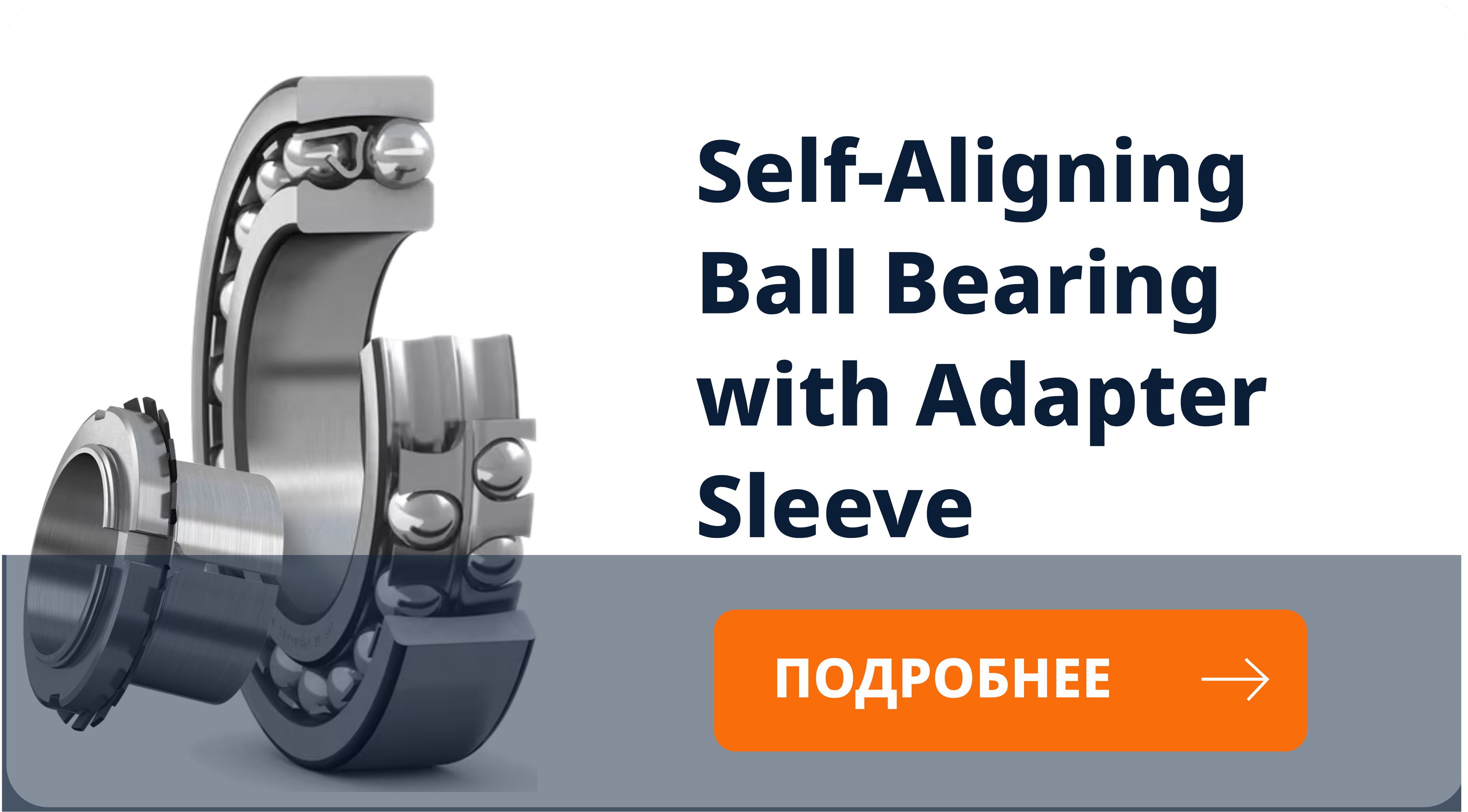
Self-Aligning Ball Bearing with Adapter Sleeve
In a self-aligning ball bearing, the inner ring has two raceways, while the outer ring has one common spherical raceway whose center of curvature coincides with the bearing axis. This design allows the inner ring, together with the balls and cage, to tilt slightly relative to the outer ring. This feature automatically compensates for minor misalignment between the shaft and housing caused by manufacturing errors, deformation or installation inaccuracies. Self-aligning ball bearings are often made with a tapered bore in the inner ring, which allows installation by means of adapter sleeves and simplifies mounting on the shaft. The adapter sleeve provides convenient mounting on the shaft with secure fixation and compensation for small seating deviations.
Main characteristics:
• high radial load capacity;
• ability to compensate for shaft misalignment relative to the housing;
• secure fixation on smooth shafts by means of the adapter sleeve;
• resistance to vibration and impact loads;
• simple installation and removal;
• increased equipment service life by reducing the risk of incorrect seating.
Design: consists of inner and outer rings, two rows of balls, a spherical raceway of the outer ring, a cage and an adapter sleeve with a nut and locking element. The spherical surface of the outer ring provides self-alignment, and the sleeve makes it possible to fix the bearing on the shaft without precise machining of the seating surface.
Application area: conveyors, fans, agricultural machinery, mining equipment, crushers, gearboxes, textile machines and industrial equipment with long shafts. Bearings of this type ensure reliable mechanism operation under vibration, misalignment and increased operating loads.
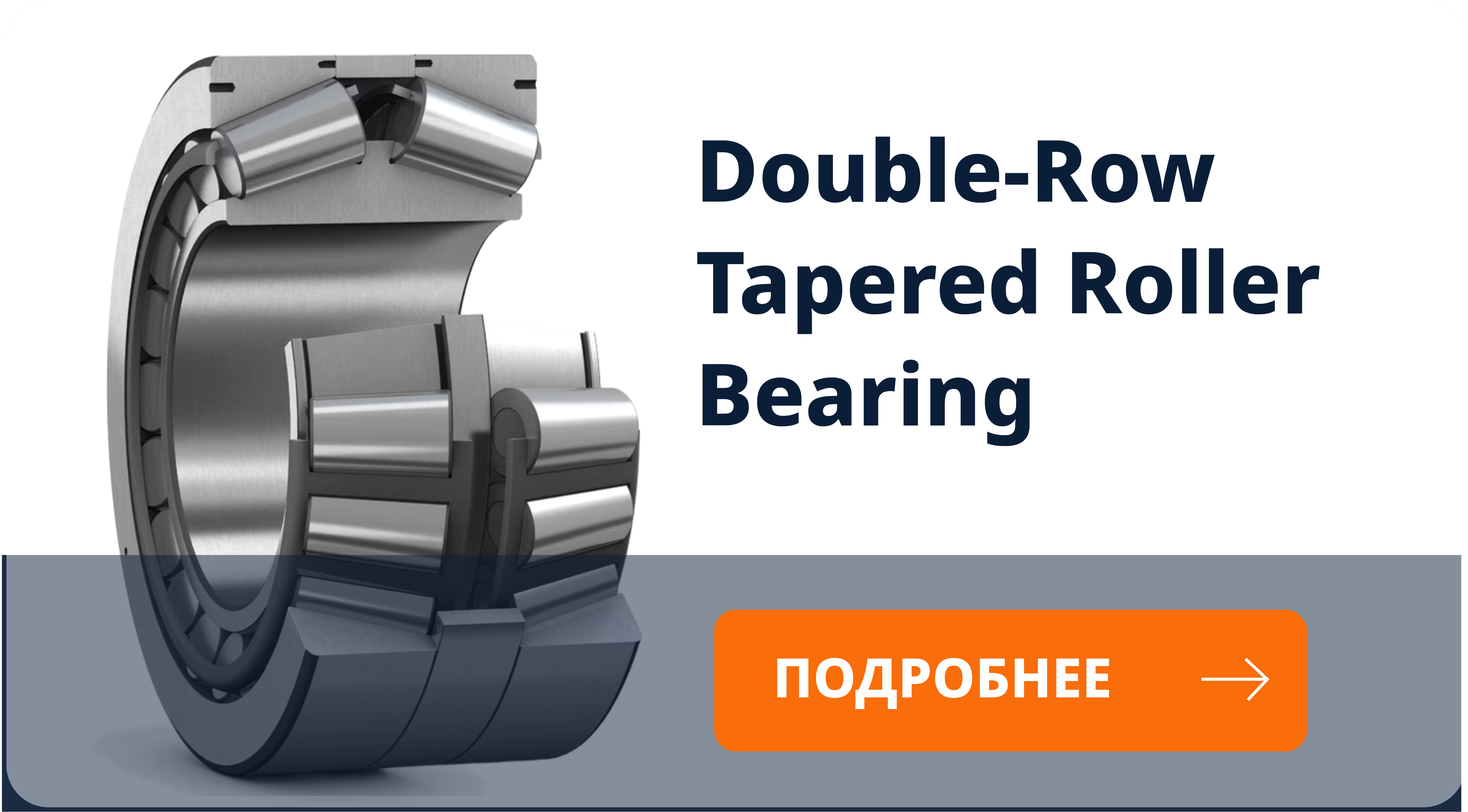
Double-Row Tapered Roller Bearing
Bearings of this type are equipped with tapered rollers guided by the rib of the inner ring. They have high radial and axial load capacity. A double-row design allows axial loads to be carried in both directions and provides increased load capacity and rigidity compared with single-row tapered bearings.
Because the design is separable, inner rings with cages and outer rings can be installed separately, making assembly easier. Depending on the contact angle, tapered roller bearings are divided into normal-angle, medium-angle and increased-angle types. In addition to single-row designs, double-row and four-row tapered roller bearings are also produced for operation under increased loads. Most designs use stamped steel cages.
Main characteristics:
• high radial and axial load capacity;
• ability to carry axial loads in two directions;
• increased rigidity and resistance to impact loads;
• operation under severe service conditions;
• even load distribution between rows of rollers;
• long service life under high loads.
Design: consists of an outer ring, or two outer rings, two inner rings with tapered raceways, two rows of tapered rollers and a cage. The separable design provides convenient installation, removal and axial clearance adjustment.
Application area: wheel hub assemblies of heavy machinery, gearboxes, mining equipment, metallurgical units, rolling mills, railway assemblies, construction machinery and agricultural machinery. Bearings of this type provide high reliability, rotational accuracy and equipment durability under heavy combined loads.
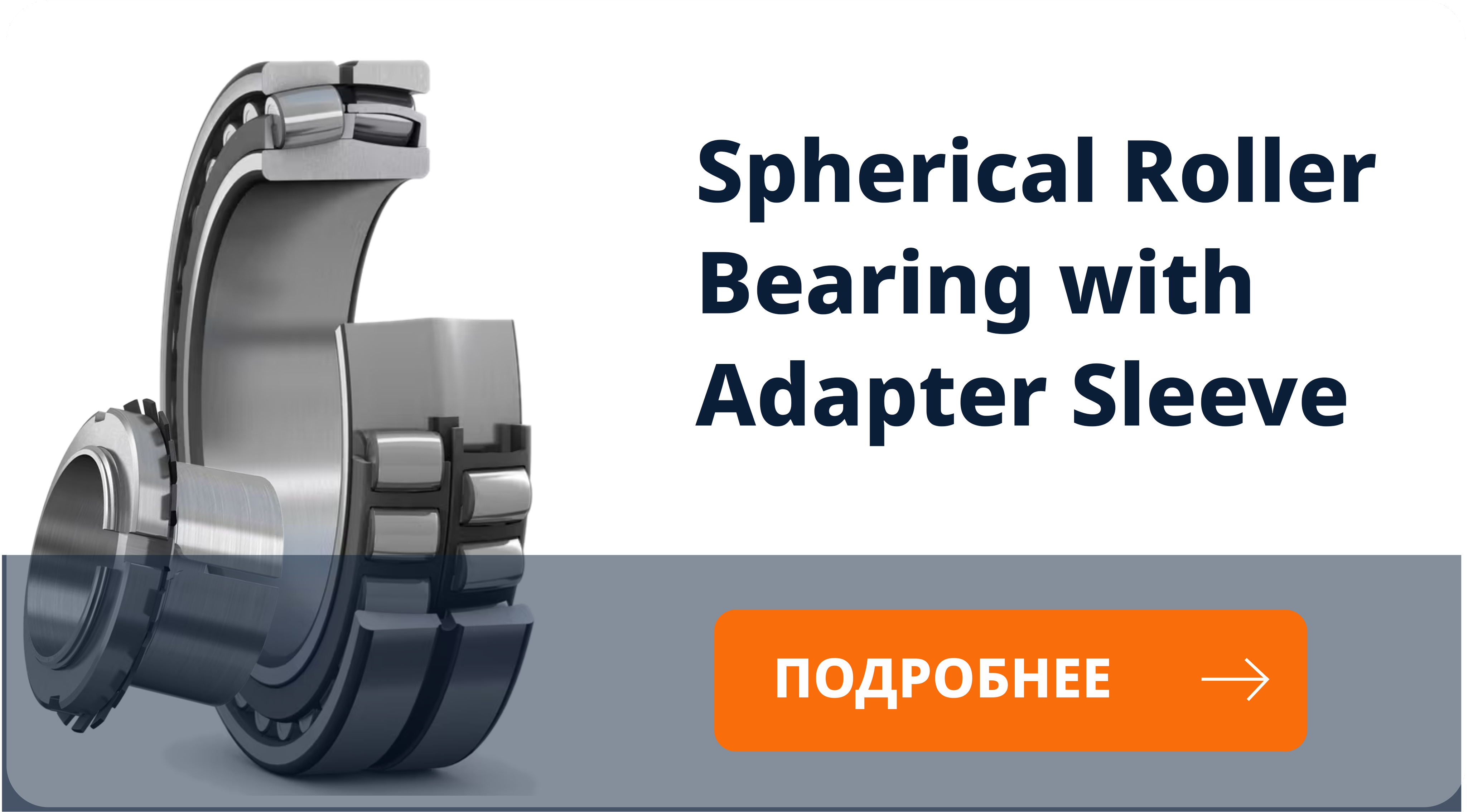
Spherical Roller Bearing with Adapter Sleeve
In bearings of this type, rollers are located between the inner ring with two raceways and the outer ring with one spherical raceway. This design provides self-aligning properties, because the center of curvature of the outer ring raceway coincides with the bearing axis. As a result, the bearing can compensate for angular deviations of the shaft and housing caused by manufacturing errors, installation inaccuracies or deformation during operation, provided that loads remain within acceptable limits. These bearings can carry radial and axial loads in both directions. They have high radial load capacity and operate effectively under heavy and impact loads. Some designs are made with a tapered bore, allowing installation directly on tapered or cylindrical shafts using adapter sleeves. The adapter sleeve provides convenient mounting on the shaft and secure bearing fixation without complex machining of the seating surface.
Main characteristics:
• high radial and axial load capacity;
• ability to compensate for shaft misalignment relative to the housing;
• resistance to impact loads, vibration and deformation;
• high rigidity and long service life;
• simple installation and removal thanks to the adapter sleeve.
Design: consists of inner and outer rings, two rows of spherical barrel-shaped rollers, a cage and an adapter sleeve with a nut and locking device. The spherical raceway of the outer ring provides bearing self-alignment, and the sleeve securely fixes the bearing on a smooth shaft.
Application area: mining equipment, metallurgical equipment, crushers, mills, conveyors, gearboxes, fans, agricultural machinery, paper machines and heavy industrial installations. Bearings of this type ensure reliable equipment operation under high loads, vibration and possible shaft misalignment.