Clearance in a rolling bearing is the distance between the raceways of the rings and the rolling elements, providing a small amount of freedom for relative movement of the inner and outer rings in radial and/or axial directions. The so-called “thermal” clearance gets its name because it compensates for temperature deformation of bearing elements caused by heating during operation. The presence of this clearance prevents excessive growth of contact stresses and eliminates the risk of bearing seizure at elevated operating temperatures.
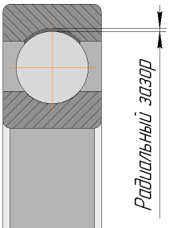
Radial Clearance
Radial clearance is the amount of free movement of the outer ring relative to the inner ring in the radial direction without an external load. It describes the possible displacement of the rings relative to each other until contact with the rolling elements occurs and resistance appears.
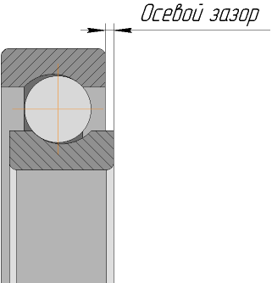
Axial Bearing Clearance
Axial bearing clearance is the amount of free movement of the outer ring relative to the inner ring in the axial direction without an external force. It determines the allowable displacement of the rings along the bearing axis until contact with the rolling elements occurs and resistance to movement appears.
Why Is Clearance Needed in a Bearing?
Clearance in a rolling bearing is necessary to prevent the rolling elements, such as balls or rollers, from jamming between the inner and outer rings during operation. It compensates for a possible reduction in the distance between the bearing rings, which may occur in the following cases:
- during significant heating of the bearing unit during operation and the corresponding thermal expansion or contraction of parts;
- when installing the bearing with an interference fit;
- when compensating for minor misalignment and displacement of the bearing relative to the mating parts of the assembly.
Clearance is one of the key factors affecting the service life and reliability of a bearing. In radial, non-adjustable bearings, radial clearance is usually considered, while in angular contact bearings, where both radial and axial clearance can be adjusted, the main focus is placed on axial clearance. Correct selection of a bearing with optimal clearances according to operating conditions helps ensure uniform load distribution between the rolling elements, reduce vibration during operation, and decrease noise generated during rotation.
Table 1. Clearance Groups
| Clearance Group | Bearing Application Conditions |
|---|---|
| Application of bearings with reduced clearance |
Need to increase stiffness in axial and radial directions. For example:
|
| Application of bearings with normal clearance group |
Relatively low rotational speeds and loads.
|
| Application of bearings with increased clearance |
Increased heating of the inner ring.
|